
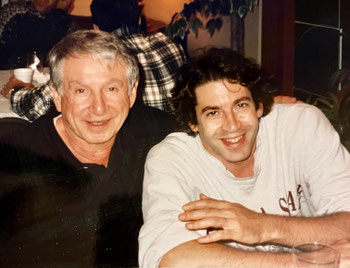
“I would do it all over again,” said Kenny Tessel, talking about caring for his father at the end of his life.
In honor of Caregiver Awareness Month, Jewish Family Service talked with Kenny about caring for his father, Eddie Tessel, who passed in October of 2024.
“I was the primary caregiver, 24-7, for my dad, for the past three years,” he said. “We used Starpoint [Home Care of Jewish Family Service] and other people to help, but people don’t realize that it takes more than one person. I was also fortunate that my dad was successful in life, and he was able to afford the extra care that we needed.”
As Dementia Worsened, Kenny Did More
For almost four years, Kenny lived with his father—first to help with errands and meals, then as Eddie’s dementia deepened, to be there for everything. “When I first moved in, my dad was still walking and cooking, he didn’t need much,” Kenny said. “Gradually, as his dementia increased, I was glad [to be there].”
After March of 2024, when his dad began to receive in-home hospice care, and couldn’t really walk, Kenny did everything his father needed. “These are the people who took care of you,” he said.
It is clear it was important to Kenny to help his father fully, physically and emotionally. Kenny stopped his business—he had had a successful career as a private celebrity chef, had run a restaurant, and was running a pet sitter business—to attend to his father full-time. And he also took care to respect Eddie’s wishes. “Dad didn’t want to go to a home and we respected that,” he said. “I agreed.”
Kenny, Too, Needed Support
For support, Kenny turned to Jewish Family Service, where he connected weekly with team leader and care manager Emily Sievers, and joined a monthly caregivers group co-facilitated by JFS and the Mayerson JCC. “I loved Emily. She was there. I talked and she listened,” Kenny said. “Emily [also] helped me find activities to keep me sane. I started taking piano lessons; that was a creative outlet for me.”
“I did what he wanted”
“I’m happy to say that when my dad passed, he knew who he was, he knew where he was, and he knew who his children were,” said Kenny. Each of these assertions was a true accomplishment for father and son.
Eddie died at 95, in October 2024, suddenly and peacefully. He had been watching a Frank Sinatra movie with his aide. “The aide told me, ‘Your father’s breathing has changed,’” Kenny recalled. “I called my sister, got her on Facetime. My little brother had just left the day before from California. The aide said maybe we should take him to a hospice location—we didn’t have morphine or any pain meds here at home. But I knew my dad wouldn’t have that. He had talked to his kids. And he was gone in minutes.”
Kenny’s voice choked up as he spoke. “We were very fortunate for that. Truthfully, I wouldn’t change my caregiving of him for a second. I would do it all over again. It’s very stressful, it’s very hard. But he was my father. I did what he wanted and I’m proud of that.”
Supporting Caregivers
Through Jewish Family Service, Kenny found information that helped him take care of his father. “You don’t have any idea at first,” he said. “The senior stuff was a mess, the Veterans Affairs stuff was difficult.” He had his siblings, but dementia and old age are a new road for most. Emily, he said, understood what comes with 24-7 caregiving. “Emily was supportive. She was there for me,” Kenny said. “I was sorry I had to let her go. [My father’s death] was still raw.… I do miss him, immensely.”
In November, Caregiver Awareness Month honors the devotion of people like Kenny—sons, daughters, spouses, and friends who show up every day for those they love. The National Alliance for Caregiving reports that, nationally as of 2025, 63 million people are caregivers, and nearly half of caregivers face financial strain.
Kenny pauses, then concludes, “He was there for me. I was there for him. That’s how it should be.”
Write a comment